
I recently got off a Podcast interview (Sandcast), with a client of mine who is transitioning out of a professional Beach Volleyball career.
The conversation was extremely insightful.
(I will share it with you once he posts it)
We talked about him transitioning out of elite sport into “what’s next?“.
However, when it comes to “transitioning” (and doing it well), it applies to us all.
Some transitions are more monumental.
And some transitions are at the very basic daily level.
For instance, I have worked with a lot of clients over the years who have been REALLY BAD at switching off from work when they get home.
Essentially transitioning from “work mode” to “family mode“.
Often it just doesn’t happen at all.
Actually, you need to actively and consciously do something (let’s call it a mindful transition), to adapt most effectively to a new environment.
How are you at “switching off” after work?
The more monumental transitions might be – using a personal example – transitioning from being an Olympic Games bomb management expert and security consultant (working for the man, literally ;-)); to being a Life Coach in Bali, working for myself, and not really having much of an idea how to go about it.
Regardless of the size or complexity of the transition, the way you do it matters.
Even in yoga, there is conscious attention given to how you transition from one pose to another, because the yogis realised its importance.
Which takes me to the key point of this conversation.
Winging it is not the best strategy
In my humble opinion, “winging it” is not a strategy that sets you up for a series of wins.
How many of us have seen some professional sportsperson transition out of the professional arena, and months later be making a name for themselves after a scandal involving excessive drinking or drugs?
They “transitioned” out of a profession where they had plenty of significance, meaning and perhaps prestige, into being … who knows what they are now?
They unlikely realised how attached they were to their personal identity as a professional athlete, and with their career over, how “hollow” it might make them feel.
Their sense of purpose was taken away as well.
So, transitioning can be pretty significant if done poorly.
There is transitioning into and out of relationships, transitioning into parenthood, and transitioning into or out of work.
ALL of them are not done well by just “hoping things work out”.
Here comes a key point.
If you are looking at a future transition, or considering a future transition, you would be very wise to slow down, ZOOM out, get perspective, and even get some professional advice to do so.
When I transitioned out of security consulting to setting up my Coaching business, one of the mistakes I made was thinking I could work it out myself.
Which is sort of true.
But it was WAY HARDER than it needed to be, especially since I didn’t given due attention and reverence to what it means to change not only professions, but my sense of self, my means of generating income, my geographical location, my access to resources, and even my activities day-to-day.
Which means my advice these days is to ask for help.
You can do it alone, and you might work it out (and there is something to be said for learning lessons truly and deeply by making your own mistakes), BUT asking for help isn’t too bad a strategy either.
Just don’t try and wing it.
Aim for CONSCIOUS AWARENESS of all the pieces and parts.
Here is a practical example of how to transition from work mode to home mode:
Create a “pattern interrupt”, which wedges SPACE between work and home mode.
It might be doing an end-of-work routine in the office (e.g. tidying your desk, making a list for tomorrow, or just taking a 5-min reflection before you head out the door), or when you arrive back home, sitting in the car and doing 5-mins of breathing (3 in, 6 out).
On the IN breath you might connect to the gratitude and love you have for the family, and on the OUT breath you are letting go of all the things you no longer need to take into the home.
Just 5-mins.
Transition done.
Time to welcome the family and the gift they are.
Don’t rush a transition
The other key point is not to rush through the transition, but learn and grow from it.
Transitioning out of a relationship?
Take your time to understand what worked and what didn’t; what you did well and what you didn’t; what values are important; what “red flags” you ignored; and what you will do differently next time.
The same with transitioning between one job and the next.
Audit the heck out of your last job to truly understand how you can do better.
Or, what do you absolutely need in your next job, and what are deal breakers?
I did my job transition audit (from the Army into my next thing), while hanging out in Tikal Ruins in Guatemala.
It enabled me to say “no” to the first job offers, and open myself to what I really wanted (international consulting work).
I sat in the transition for long enough to understand that what I wanted most in my post-Army job was international travel.
Have you learned all you need to in your transitions, so you don’t make the same mistakes again?
In Summary
We all face transitions in our life (some bigger than others).
Slow done, take some breaths, get perspective, and then work out how you will (strategically) transition to the next thing.
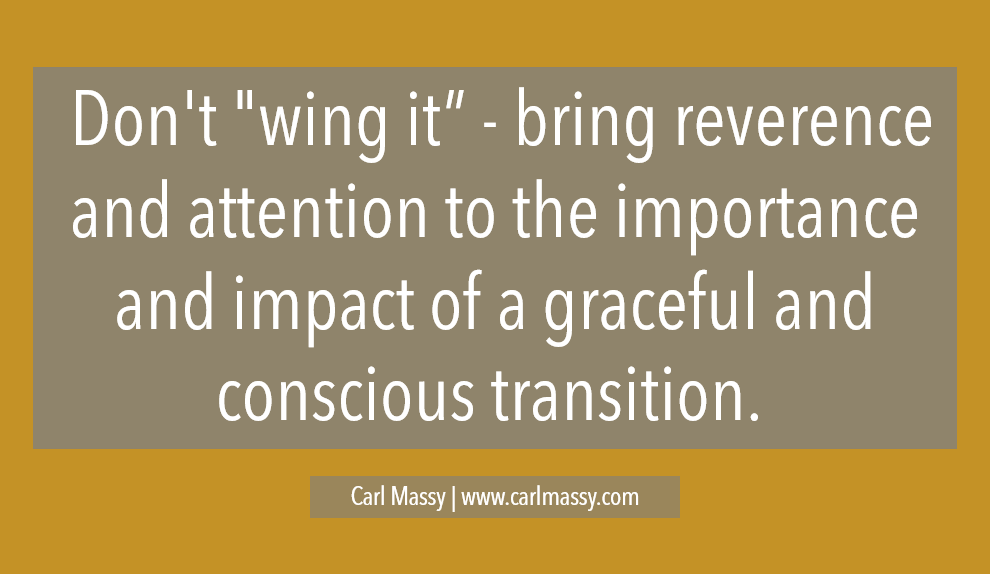
Don’t “wing” it – bring reverence to the importance and impact of a graceful and conscious transition.
The bigger the transition, the more you will benefit from some expert, external help (it will pay off big time in the end).
Use your transitions well, by not rushing them, thus enabling you to make much wiser future decisions.
My Parting Words
A short but relevant newsletter article today.
And next week I will share with you the podcast interview with Tri Bourne on the Sandcast Podcast (he has such a cool name :)).
We covered plenty of ground, over and beyond transitioning, which he is currently going through.
As I said, the main point is to give due respect and reverence to the importance of a transition.
To really sharpen up your conscious awareness and higher perspective, so you can navigate it gracefully.
Also, don’t “assume” it will be easy, as that may mean you don’t show up with 100% attention or willingness to do the work.
Like I have said MANY times before, life doesn’t have to be HARDER than it has to be.
There are no extra brownie points for getting to the finish line having gone the absolute hardest way.
Yes, there might be personal points to give yourself, but no need to make it a habit.
Last question: How are you at transitioning from work mode to home mode?
I am just curious.
Have a smooth and cool day, and a week of graceful transitions.
Take care.
Carl
Quotable QUOTE:
“Don’t “wing it” – bring reverence to the importance and impact of a graceful and conscious transition.” Carl Massy
(Author of 18 Ways We Make Life WAY Harder Than It Needs To Be)
PS: Have you read or listened to this book yet? 18 Ways We Make Life WAY Harder Than It Needs To Be