
The one thing we DO NOT want to do, when it comes to getting out of an emotional state of anger (or the likes) is to SUPPRESS our feelings of anger.
We might have been taught this growing up.
We might have even had parents who modelled the “stuff it down and hope it goes away” strategy; but I am here to tell you that is a super crappy strategy, which is sure to bite you on the butt at some point in the future.
And sometimes it bites HARD!!!
So, the first thing, not to do, is suppress your emotions.
Probably in the same sort of vein – though maybe not as harmful – are ignoring the feeling, distracting yourself from the feeling, or numbing it out.
Again, these are all pretty substandard strategies.
It (the icky emotion) might suck, but there is a lot of relevance to the saying “you need to feel to heal“.
Which leads me onto my next big no-no.
DO NOT DO THIS:
Never, ever, ever, tell yourself you “should not” be feeling what you are feeling.
That is called denying reality.
And it has a tendency to spiral you to an even deeper level of whatever emotion you are feeling; with the possibility of some other emotional gunk being attached at the same time.
Please promise me, that if you have a habit of doing this, you will kick it out of your habitual playlist ASAFP.
ACCEPT you are feeling what you are feeling (anger, rage, apathy, despair, frustration, embarrassment, etc.).
Strangely enough, this can already start defusing of your emotional state.
What is okay to do (IMHO)
I personally think there are things that are quite okay and healthy to do, when it comes to dealing with reactive emotional states.
I think it is okay to yell, kick things, jump up and down, or the likes, PROVIDING you do not harm yourself, others, or create possible future negative consequences.
I have been working on this stuff – in significant depth – for about 26 years now, and I still lose my sh#t on occasion.
But here is the thing.
I don’t measure how I responded at the front end (providing I caused no harm).
I am much more interested in how QUICKLY I can get back to a state of equanimity.
I am also not trying to figure out how to solve things UNTIL I get back to a state of calm (so I can use the frontal lobes of my brain and my higher mind).
In my opinion, unless it is a life of death situation, I don’t need to immediately figure out the solution to the thing that triggered me.
We generally – in 99% of cases – have time to calm down (and get to that low resting heart rate like the high-performing athlete), before we need to act.
It is actually in our best interests to do so.
The athlete also realises – to perform at their peak – they may need to take a break, to get their heart rate down, before they race off for the next physical activity.
In Summary (and the key takeaways)
Suppressing, avoiding, ignoring, numbing, or distracting, your reactive emotions is a poor strategy.
You need to actually feel the emotion you are experiencing, even if you don’t like it.
DO NOT (EVER) tell yourself “I should not be feeling what I am feeling“, as this is denying REALITY, and will likely cause a downwards emotional spiral.
Express verbally or physically the emotion working through you, providing you cause no harm to yourself, others, or create future unhelpful consequences (i.e. this is probably best expressed in private).
Until you reach a state of enlightenment, accept that like the rest of us, you will get ticked off on occasions, and it is not a sign you are defective.
Remember the aim is not to ever feel ticked off, it is to be able to QUICKLY (or as quickly as possible) return to equanimity.
Unless it is a life-or-death situation, finding the solution to your “problem” can wait (and is best waited for) until you calm down.
(And to repeat) Emotional Fitness is not about never getting pissed off, it is about how quickly you get back to a state of calm, after losing your sh#t!
My Parting Words
A conversation about this topic came up recently in a client coaching session.
This person was caught in the downward spiral of telling themselves that “they should not be feeling angry and frustrated every time XYZ happens“.
Step 1 is to accept the “reality”.
The reality is that they do.
Then the next step is to work out if it is an internal thing (mental or unconscious), or an external behavioural habit, or most likely a combination of both.
So the result is a combination of some inner work (especially around I was kinda a bit embarrassed the other day at my gullibility.
I was showing my partner – Ferry – what I thought was a cool video of some animals caught ‘on film‘ with amazing reactions.
Only to be told by Ferry “It’s AI”.
Bugger!
How good are you at telling what is “AI” and what is “REAL”?
It is getting harder and harder.
And then there are the scams, and scammers.
The latest scam I have landing in my Inbox, is inviting me to be a Guest Presenter at a wellness conference in the USA.
Something I am normally up for, and it is not an uncommon request for me.
But something was off.
It was missing key links to the conference details, or website to showcase the event.
So I knew it was a scam.
They probably would ask for some money to cover certain expenses, or secure yourself the spot, or the likes.
For a younger me starting out, and having their ego stoked by getting an invite to be a guest speaker at a major wellness event, you can see how easily someone could be enticed into this crafty (and very unethical) scam.
So, I thought today we would talk about what skill might make us more scam-proof.
Interested?
The key SKILL I have in mind
The skill I believe, which not only makes us more scam-proof, but makes us more effective in anything where a decision is required is…
Drum roll please…
DISCERNMENT.
The ability to “discern” fact from fiction, truth from lies, credible versus dodgy, and real from fake.
Now THAT is definitely a skill I want in my hip pocket, plus the super-duper-pimped-up version please.
So, how do we build up our Discernment muscles?
Building your Discernment Muscles
Want to know something?
The ‘real’ yogis were always more interested in building mental skills and mental muscles (which they refined over 100’s and 100’s of years), rather than creating great poses to someday make it into the spotlight on Instagram.
Creating a powerful mind was their primary jam.
Laser focused. Creative. Intuitive. Unshakeable will. Energy efficient. Non-reactive. Calm. Stable. Ability to hold two seemingly opposing views in mind and be at peace.
Their primary practices to build a powerful (and discerning) mind, involved intentional movement, pranayama (intentional breathwork), and a range of different meditations.
The benefits of the breathwork are to influence the autonomic nervous system, but a by-product also included increasing the amount of oxygen into the lungs, which ultimately meant more oxygen into the brain for peak optimization.
With meditation, among its many benefits, is the development, and probably recalibration of the right hemisphere of the brain; which is believed to be more related to creativity, and more specifically to give us CONTEXT.
Meaning, we can see the thing being offered to us (choose your scam), in the greater context of reality, to better see what seems right or wrong, probable or improbable, real or fake.
So, the greatest way to build a higher level of discernment is working on the quality of our minds, including building a seamless integration between our mind and body, so we can tap into all of our discernment resources.
To keep things practical, let me jump into (in no particular order of priority) some more tactical RECOMMENDATIONS for building our discernment muscles:
1. Slow down, step back, take a breath and create space between you and the person trying to convince you of something. This allows you to recalibrate, ground and get more centred.
2. Check in on what your gut is telling you (my belief is that the millions of micro-organisms in our gut have millions of years of evolutionary experience, determining whether something is life-giving or life-taking, and can send this information up the vagus nerve to our brains; and why the gut is often called the second brain). Get out of your head, and check in on your gut.
3. Drop into the deep inner wisdom of your heart. What is your heart (not head) telling you? Does it feel right? Is it pure or coherent?
4. Do due diligence. Which often means deeper or broader research. Don’t just trust once source, and definitely do not just trust “Headlines” or “sound bites”. Go deeper.
5. With person-to-person communication look beyond the words, and observe their entire body language. Are they shaking their head when they say “yes”? Are their eyes all over the place? Do they over-blink or not blink at all? Maybe they are rubbing their eyes to avoid eye contact. Are they fidgeting a lot?
6. Build up a friends list, or online sources, who have proven over time their integrity, and their depth of compassion and care for people and humanity in general.
7. Never allow yourself to be forced, pressured, influenced, or cajoled into making a quick decision. Take your time (and if that is not acceptable to them, walk away).
8. Build your knowledge base. Read more. Study. Ask more questions. Ask for clearer explanations.
9. Do physical practices which intentionally focus on the integration between your body, mind and spirit. E.g. Yoga, Thai chi, Qigong, and more traditional martial arts.
10. In online communication, with unknown sources, either delete them immediately, or do a background check on their website, social platforms, or an online knowledge market like Quora. Just like when investigating body language, look for spelling or grammatical errors, branding discrepancies, odd email addresses, lack of open-source contact details, lack of a professional website, and other tells. But, always, if in doubt, DELETE.
11. If you have a bias to action created by a “fear of missing out” (FOMO) habit, it is time to do some work on this. What is its root cause? What beliefs, emotions and behaviours support this pattern or program? If you are not sure how to work through this, get in touch with me, and we will figure it out together.
12. In alignment with the above, our inner landscape and dialogue, can make us more ‘susceptible‘ to being taken advantage of (e.g. a need to be liked, a fear of looking ‘dumb’, a lack of self-worth, feelings of powerlessness, etc.); so we need to clean the inner house of our mind.
And do let me know if there are other strategies you would also add to the list.
In our modern age, and in the years to come, our ability to DISCERN what is good for us, and what is not, is going to be made much harder by AI; our exposure to a global market (and a global range of scams and scammers); societal encouragement and celebration towards fast action; more intelligent marketing; greater exposure to people with low ethics (the global effect again); political agendas; less face-to-face (and heart-to-heart) communication; and generally lower inter-personal skills due to technology (e.g. social media platforms, the internet, smartphones, etc.).
Hence the need to build up this muscle through deliberate practices and strategies.
In Summary
Building up our ability to be better at DISCERNING good from bad is an ESSENTAIL skill in these times and beyond.
Discernment is a whole body – mind, body and spirit – skill.
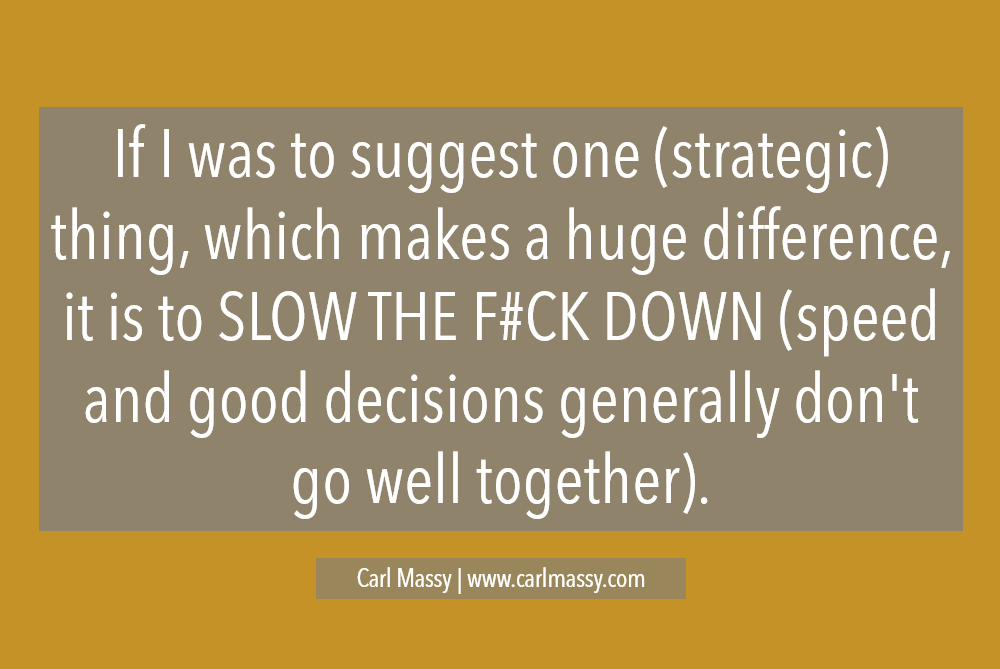
If I was to suggest one (strategic) thing, which makes a huge difference it is to SLOW THE F#CK DOWN (speed and great decisions generally don’t go well together). 😉
The other very simple thing, which is made possible by slowing down, is BREATHING DEEPLY for a few minutes (this positively influences the nervous system, plus the availability of oxygen and energy for the brain).
My Parting Words
We live in interesting times.
The world is changing, and it is changing pretty rapidly.
Which means, one of the best things we can do to counter this, is to slow down.
That does not mean we stop dreaming big.
I still believe that our ‘Dharma is Greatness‘.
It is just that the most powerful thing us humans have is a highly creative and intuitive mind.
We also have access to this thing called consciousness, which when used well, can plug us into all sorts of extra sensory perceptions.
But again, if we are going at a crazy pace on the hamster wheel, we cannot tap into our full potential.
And our ‘discernment‘ is also likely to suffer.
So, maybe the key to a high level of discernment, is to find ways to slow down, centre, ground and connect to the all of what we are (body, mind and spirit).
Stepping us into our very powerful potential.
I remain convinced that we are WAY more powerful than we have been lead to believe.
When we truly tap into our greatness, we won’t even be able to measure it on the ‘Richter Scale’.
Bring on the GREATNESS!!
Have a great day, and a week tapping intuitively into any still-dormant Greatness residing within you.
Take care.
Carl
Quotable QUOTE:
“If I was to suggest one (strategic) thing, which makes a huge difference it is to SLOW THE F#CK DOWN (speed and great decisions generally don’t go well together).” Carl Massy
(Author of 18 Ways We Make Life WAY Harder Than It Needs To Be)
PS: Have you read or listened to this book yet? 18 Ways We Make Life WAY Harder Than It Needs To Be